
The Preservation of a Language
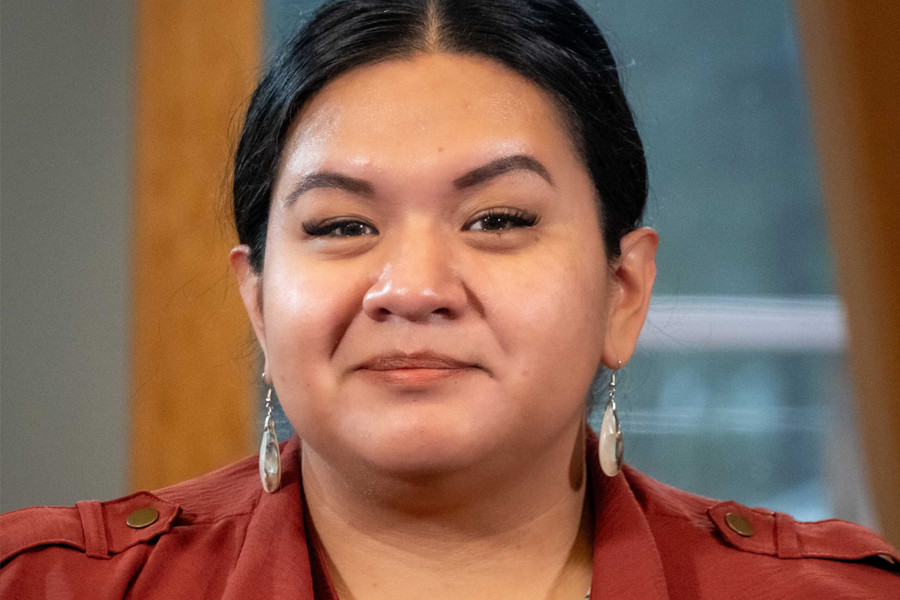
Language serves not only as a medium of communication but also as a fundamental component of culture, reflecting and shaping a community’s societal values and beliefs. In many cases, such as with the Alaska Natives of Saxman, their cultural language is endangered. A language is considered endangered when there are only a limited number of native speakers. Preserving the Tlingit culture of our shareholders has been a priority for Cape Fox Corporation (CFC) for many years. This year, CFC sat down with Lisa Milne-DeWitt, also known by her Tlingit name, Yakdushí, to spotlight her for the 2025 Shareholder Spotlight, highlighting her work in preserving the Tlingit language and a significant part of Tlingit culture. She is of the wolf moiety from the Naanya.aayí clan. Lisa is a Tlingit language and culture teacher. She is a Tlingit language heritage facilitator at the Ketchikan Indian Community (KIC) Education Department. Lisa did not grow up speaking Tlingit, though. She became passionate about her language after hearing her great-grandfather speak it.
Lisa admitted that she did not grow up learning to speak Tlingit and considers it her second language. She began to show an interest in the language when she heard recordings of her great-grandfather speaking it in the 1980s. She understood that hearing him talk in Tlingit was special, and it brought her to tears as she recognized that the language revealed how her ancestors had lived on the land. To hear the language of that land gave her a sense of belonging and heritage.
Since she did not grow up learning the language, she was asked what sparked her interest in the Tlingit language at a time when it was not widely spoken among families. She said, “I think it was learning the different ways that the Tlingit people viewed and lived in this world, took care of the land, treated each other, lived amongst each other, embodying those traditional tribal values, sense of community, the way we connect beyond the immediate family structure that we know today. “
So, how does one learn a language that is endangered? In fact, it is estimated that there are only a little over 60 native Tlingit speakers left (CANL Biennial Report), and most are elderly. While there has been a revival of individuals wanting to learn the language, they are often left to various other resources. Yakdushí got interested in learning the language when she attended the University of Alaska Southeast and saw a Tlingit language course being offered. That was her first real introduction to the language where she learned the structure and depth and not just a few words or phrases with teacher, Kaakal.áat Florence Sheakley. There are many tools and resources out there to learn the language, though and she utilized everything she could to do that. When Yakdushí started with KIC in their education department, she utilized every resource she could find to help her learn, such as, taking university classes again with Dr. X’unei LanceTwitchell, finding other teachers like Lgeik’i Heather Mills, along with a few others along the way. Having books, recordings, and fellow Tlingit language enthusiasts and study groups, and then practicing, which grew her Tlingit language skills greatly.
The English language has evolved into a world language with a flexible grammar system. When someone learns English, they typically start by learning the 26 letters of the alphabet and each sound. Like English, Tlingit is a phonetic language, but it has 50 sounds, almost double as English, and each has its own distinct sound. You cannot combine any sound to make a whole other sound to start forming words and phrases. In fact, four of the 50 sounds are not found in any other language in the entire world.
Tlingit is also an oral language. The language did not become a written language until 1962, when linguists started to study and record the language. As a result, the orthographies, or spellings, have changed over time. The 50 sounds are still evolving in written form. There is not an established orthography for one Tlingit language because there are many other dialects, which also means the grammar of each dialect can be different. In the Ketchikan area, there are three, the southern dialect (aka Saanya Dialect), the Sanya dialect and the Taant’a dialect – the Taant’a dialect is distinct and there are no more birth speakers or individuals who speak Tlingit as their first language. That is why holding onto the resources is so important.
As most understand, the most effective way to learn a language is to immerse yourself in it. Unfortunately, with Tlingit, the immersion style is very rare and a special opportunity. So, even if you can identify grammar or nuances, having a community to speak the language is likely the best way to progress your learning of Tlingit. At the same time, another component is building up your skills to feel confident. Often, when trying to learn Tlingit, which should be our native language and culture, we may feel guilty or negative feelings for not knowing it. As Lisa says, “Always be open to learning. Be confident enough to be a learner.” After you do that, you will realize that you are transitioning from being a learner to having a Tlingit way of thinking, or Lingít Tundatáani.
In Lisa’s classroom, she teaches both language and culture. She will teach her kids words and phrases, and then discuss cultural components, such as social structures or the history of the Tlingit language. Lisa likes to use an applied teaching method. She does not want anyone to rely on books to learn about language and culture. She prefers a more dynamic approach with group discussions, shared experiences, and anecdotes.
“One of the reasons I love the language and the culture of Tlingit is that the language has so much more meaning and depth. The language has the words for just what you feel, want, or need. One of my favorite phrases is “i tóo yèi yatee.” Or It is within you. And one of my favorite is yakgwahéiyagu which means there is a spirit in everything. These are great examples of how the Tlingit language can explain the world. Another great example is the word for thank you, Gunalchéesh. It means so much more in Tlingit. The literal translation is, “without you it would not be possible.” Much of Tlingit adds a depth of meaning and emotion to its phrases and words.”
Lisa’s advice to anyone wanting to learn Tlingit is to start by listening. There are exceptional resources and books to help, but it should start with listening. Then, slowly replace your habits and words with those you have learned. Finding small pieces to work on instead of taking the language as a whole, start with small steps. First, begin by listening to the language. For Lisa, finding her small pieces to hold onto has included learning the different words and dialects from northern and southern Tlingit, as these are essential to the history of her culture and language. The pieces are out there to learn, but it also speaks to the fact that so much of the language has been lost already, and there is a need to bring it back, preserve it, and, in essence, keep the Tlingit culture alive and thriving.
Lisa commented that, “The Tlingit culture is very intentional with words, actions, gifting, just like the language, the culture, and traditions have such depth which comes from a place of love, family, and community.” There is a growing number of youths who are interested in learning about their Tlingit culture and language. The youth are looking for their identities; what is their clan, house, village? Learning the language and culture gives them a deeper understanding of themselves within the Tlingit culture.
To anyone wanting to learn the Tlingit language, Lisa shares a phrase she got from her teacher, “ix’adudlatseen,”(Heard from one of my teachers, Kingeistí David Katzeek.) which means you are precious. The language belongs to the land and to its people. It deserves to be spoken, but we have to bring it back together. “Our ancestors’ words need to fill the beach, the mountains, reach every tree, fill every boat, and be heard on our land again. People need to come to Tlingit land and hear Tlingit.”
ix’adudlatseen – Tlingit for “You are Precious.”