
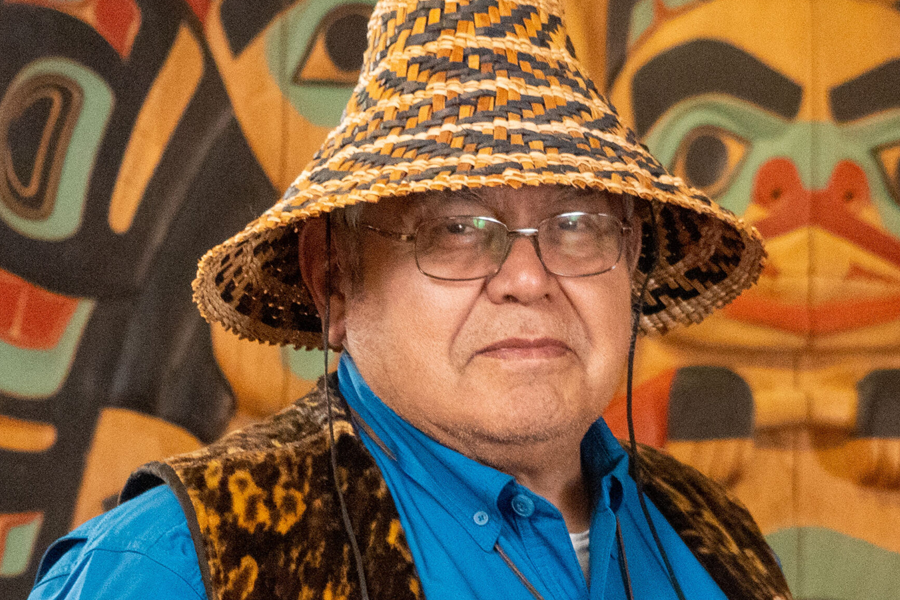
Spotlight of a Legend
Often, there are people in this world who make us sit up and pay attention every time they speak. Each story or anecdote becomes a jewel of learning and meaning. These are the people often referred to as living legends, and this year, Cape Fox Corporation (CFC) is spotlighting one of its greatest living legends, Richard Shields, Sr. Being a legend can mean you are famous, but it also means that you live your life well and purposeful and act as an example to others. Richard is an example of the true meaning of a legend. When he speaks, people are interested. There may be a softness to his voice, but the weight of his words often touches and makes people respond to what he is saying. We are delighted to spotlight this remarkable son, father, brother, uncle, nephew, grandfather, community leader, and former CFC Board member.
Richard was born in the Ketchikan area. His Tlingit name translates to Ten Eagles Sitting in a Circle. He is a well-respected community member who has served on the Saxman city council and has been a CFC board member for 43 years. Richard makes everyone feel important and never hesitates to thank people. He is respectful of traditions and cultural processes. He is a wealth of knowledge who speaks with intention and is always eager to answer questions on culture and history.
In November 1980, at the election of Board members during the Annual Meeting, Richard was voted onto the Board. He has served on CFC’s Board for 43 years, and for the last eight years, 2015-2023, he was Chairman of the Board. Richard holds the esteemed privilege of being the longest-serving Board member in CFC’s history. Richard speaks fondly of his early years on the Board. He said that he “absorbed everything around me. I listened to how they handled issues, and then later, I started to become more vocal myself. I made mistakes, but everything I did was for the shareholders. We had a lot of obstacles to overcome early on, but we did, and look where we are today.”
Supporting CFC shareholders is always at the forefront of what Richard does and how he led his decisions while on the Board. For Richard, being a Board member is not a right but a privilege and an honor. Richard speaks much of his time on the Board and his work and support for the shareholders, but one of his greatest wishes is to see more youth representation on the Board. The youth are the future; the company is their future. He sees the importance of many of the younger generation starting to work at a tourism level for the company, and now wants to see more become involved at the political level. Doing this teaches them how to work together and put aside anger and personality. He wants them to come to the table and know to listen and “not jump with what your mouth will say but what your heart will say.” Most importantly, he hopes that when the younger generation joins the Board, they do it by keeping shareholders in mind.
Richard pointed out that when he got involved, he had zero knowledge of tourism and corporate operations, but he listened to the elders intently, and he learned. He felt privileged to sit with the elders who were the leaders of our community. He learned much from watching and listening to them. His father taught him the importance of standing up for people and saying thank you. “Saying thank you taught me to get up to speak, and saying thank you can help to start with a lot.”
The largest part about becoming involved is to start learning. In Richard’s words, “The youth are the ones that will take over, and soon it won’t be a choice, and they will have to do it or not and, if not, it will collapse. It would be great to pull them back into the meeting room so they can be involved and learn. We need to pull more youth into the meetings to give them experience. The Board will be theirs someday, and they will have to step up to the table. I hope we get them involved sooner so that they know how important it is. They have to work and discipline themselves to get themselves involved.”
As a lifelong storyteller, Richard has captivated many with his lore and his discussions on tradition. So, it is no wonder that when he speaks of the history of CFC, it is as a storyteller. For him, the corporation has a story. It is the job of the Board and its shareholders to keep it alive through the constant need to keep sharing. As Richard equated, “When you hike a trail, there are curves and ups and downs; that is like working with an organization. There are a lot of obstacles out there. If you make the right decision, you will work around the obstacle. The valleys are like the hard times when you struggle, and you work, but you keep working because what you think of is your shareholders, and soon you begin climbing up. Again, it is the trail; it is not an easy climb, and there are obstacles, but you have to keep going.”
Finally, as any great legend and storyteller, he gave his sage advice, which he would often share with the youth of the community. One of the greatest traditions that he would like passed down generations lies in one word: RESPECT. He wants to see respect for everyone. “Sometimes it is challenging to hang on and to give. Issues can make you blind, but through respect, we may be able to see clearer.”
Richard has been a large part of CFC’s 50 years of history. He has enjoyed learning the operations of the business, including the 8(a) program, as CFC entered the government contracting field in 2003. For the next 50 years of CFC, Richard hopes to see even greater growth but to start by working with what we have already and then moving diligently and effectively step by step.
Richard has led a life of grace and respect. Family and shareholders are important and the basis for all his decisions. For him, if shareholders are healthy, we are healthy, and the corporation is protected. Richard ended by saying, “When I say I love you, I am saying I care about your well-being, I care about your health, I care about what is going to happen to you. It can take a long time to learn to say I love you. But it doesn’t need to be romantic… it could be caring. That is how we take care of family and friends, by letting them feel they are cared for.”